Management

Applying assessment and evaluation in instructional design practice.

Non-Instructional Intervention: Communication

Course: EDIT 7150E – Principles of Human Performance Technology and Analysis
Instructor: Dr. Jill Stefaniak
Focus: Communication systems, performance improvement, information flow, organizational alignment, HPT interventions
Tools: Human Performance Technology (HPT), Communication Systems Analysis, Job Aid Design, Organizational Mapping
Responsibilities: Analyzed organizational communication systems, designed performance support interventions, evaluated communication networks and feedback loops, identified breakdowns in information flow, and developed solutions to improve clarity, coordination, and organizational alignment.

Non-instructional intervention focused on improving organizational communication through structured systems that support performance, alignment, and information flow. This artifact applies Human Performance Technology principles to analyze communication networks, feedback loops, and workplace communication systems. The design emphasizes clarity, coordination, and performance support across organizational teams.

Project Context & Highlights

The Problem

Workplace learning ecosystems often suffer from friction when relying purely on memory-dependent training. Without contextual, just-in-time performance support assets embedded directly into the daily workflow, users face cognitive overload, leading to operational inefficiencies, execution inconsistencies, and communication breakdowns.

The Learning Solution

A learner-centered, non-instructional performance support tool engineered to reduce cognitive friction at the point of need. By synthesizing complex communication networks into an intuitive, visually structured job aid, this solution scaffolds task execution, removes dependencies on rote memory, and empowers users to self-navigate professional workflows with immediate clarity and high precision.

Highlights

  • Selected non-instructional intervention over training to address performance gaps
  • Used job aid format to support real-time task execution
  • Aligned performance support with workplace learning needs
  • Focused on usability and immediate application in professional contexts
Design Decisions and Reflection

Process Overview

This project focuses on organizational communication intervention, a type of non-instructional intervention that helps improve performance by aligning how information is shared across an organization. A non-instructional intervention is an activity designed to change performance by targeting systems, people, or processes rather than simply providing instruction or instructional intervention alone. In this case, communication intervention focuses on improving how information flows. Communication is a process through which people acting together create, sustain, and manage shared meaning. Organizational communication aligns messages, reduces misunderstandings, and ensures everyone is working toward the same goals.

Effective communication is critical because it ensures coordination, reduces misunderstanding, and aligns actions with organizational goals. Poor communication can create errors, reduce engagement, and slow performance. Within the Human Performance Technology Model, organizational communication is one type of intervention alongside learning, performance support, and human resource development.

This project included several communication interventions. Communication networks describe how messages flow in an organization, including formal chains of command and informal peer-to-peer channels. Information systems provide structured ways to deliver consistent information such as dashboards or newsletters, helping standardize messages across teams. Suggestion systems allow employees to submit ideas, recommendations, or feedback to leadership. Grievance systems provide formal ways for employees to communicate concerns safely. Dispute resolution systems help resolve conflicts through structured communication rather than escalation. Cross-functional alignment ensures different departments are on the same page. Feedback loops help check understanding and adjust communication as needed. Communication barriers such as noise, jargon, unclear channels, and competing messages can distort information and reduce understanding. These barriers impact coordination and alignment across an organization.

Justification for Inclusion

This artifact is placed under Management because it directly demonstrates the ability to plan and manage activities and projects through structured communication systems. Management in instructional design is not only about creating learning solutions, but about coordinating systems, people, and processes so that work can be implemented effectively. Organizational communication intervention is a focus on how information is structured, delivered, monitored, and improved across teams. It shows how communication networks, information systems, feedback loops, and formal processes such as suggestion, grievance, and dispute resolution systems support project coordination, alignment, and performance. This makes the intervention a clear example of managing how work is organized and how people interact within a system to achieve shared goals.

Including this artifact in my portfolio is important because it demonstrates my ability to think beyond instruction and design at a systems level. It shows that I understand how performance is influenced by communication structures and how improving those structures supports organizational effectiveness. This connects directly to my growth because it reflects my ability to manage design challenges, collaborate with teams, and support stakeholders through structured communication processes. It also supports my broader professional goal of working in learning experience design, where managing communication, alignment, and stakeholder understanding is essential to successful project outcomes. This artifact highlights my ability to design interventions that improve coordination, reduce misunderstandings, and strengthen overall performance through intentional communication system design.

Value and Self Assessment

This artifact was also informed by Van Tiem et al. (2012) in Fundamentals of Performance Improvement, which deepened my understanding of Human Performance Technology and non-instructional interventions. The text particularly resonated with me in how it framed performance improvement beyond instruction, emphasizing systems, processes, and organizational design. I was especially interested in the concept of non-instructional interventions as practical tools that can be applied within complex systems to improve performance. Rather than focusing only on communication barriers, this work helped me see communication as part of a broader system of support structures that can be intentionally designed and improved. I found this perspective engaging because it shifted my thinking toward more systemic, scalable solutions that go beyond training and can be embedded directly into organizational workflows.

As a teacher, this artifact shifted how I think about supporting learning and performance beyond the classroom. It reinforced that many challenges I see in practice are not always solved through additional instruction, but through clearer systems, better communication structures, and more accessible supports. The focus on non-instructional interventions helped me recognize the importance of designing environments where expectations, resources, and information are clearly aligned so students and colleagues can function more effectively.

This perspective also connects directly to my teaching practice, where communication, routines, and systems often determine how smoothly learning occurs. It helped me see value in designing supports such as structured processes, clear communication channels, and embedded tools that reduce confusion and increase independence. Overall, this experience strengthened my ability to think as both an educator and a systems designer, considering how classroom and organizational structures impact learning, behavior, and performance.
Needs Assessment Decisions & Performance Analysis

Course: EDIT 7150E – Principles of Human Performance Technology and Analysis
Instructor: Dr. Jill Stefaniak
Focus: Needs Analysis, Performance Gap Identification, Stakeholder Collaboration, Systems Thinking, Data-Driven Decisions
Tools: Canva, Human Performance Technology (HPT) Frameworks, Stakeholder Analysis Matrices, Collaborative Data Systems
Responsibilities: Served as a core collaborative designer and project coordinator. Spearheaded early-stage project organization, designed the cross-functional meeting alignment plan, managed centralized team asset workflows, facilitated targeted stakeholder outreach and survey deployment, and structured cross-functional data synthesis to isolate performance gaps.

This artifact showcases a collaborative needs assessment and performance analysis matrix that serves as a direct reflection of evidence-based, cross-functional decision-making. It documents the structured process of defining complex organizational problems, isolating high-impact data sources, synthesizing mixed-method metrics, and translating findings into defensible, actionable insights. The project highlights a deeply learner-centered approach to performance consulting, illustrating how stakeholder integration and strategic data coordination uncover actual performance gaps to optimize organizational readiness.

Needs Assessment Preview
Assessment Decision Preview

Project Context & Highlights

The Problem

Organizations frequently face fragmented data collection, misaligned stakeholder inputs, and a lack of analytical clarity when mapping performance discrepancies. Without a rigorous, systematic methodology to isolate root causes, modern design and business teams risk deploying costly instructional interventions that treat superficial symptoms rather than fixing fundamental performance gaps.

The Solution

Leveraging Human Performance Technology (HPT) and collaborative design thinking, our team engineered a dynamic visual decision-making model using Canva. This framework systematically structures stakeholder inputs, aggregates multi-channel metrics, and anchors qualitative and quantitative data into clear, objective indicators. This model maps out clear paths from analysis to action, ensuring interventions directly support human performance goals.

Collaboration & Project Coordination Focus

This artifact demonstrates high-level, human-centered collaboration and project steering. It reflects an agile approach to coordinating cross-functional team inputs, structuring collective synthesis workflows, and aligning varying internal viewpoints into a unified, evidence-based performance roadmap.

Key Project Milestones

  • Applies systematic Human Performance Technology (HPT) models to organizational ecosystems.
  • Translates complex stakeholder feedback into actionable, structured data visualizations.
  • Establishes efficient digital file architectures and meeting tempos to maximize team alignment.
  • Utilizes Canva to drive real-time, co-creative, and iterative asset design.
  • Maintains a continuous learner-centered focus by balancing high-level strategy with targeted end-user feedback.
Design Decisions and Reflection

Process Overview

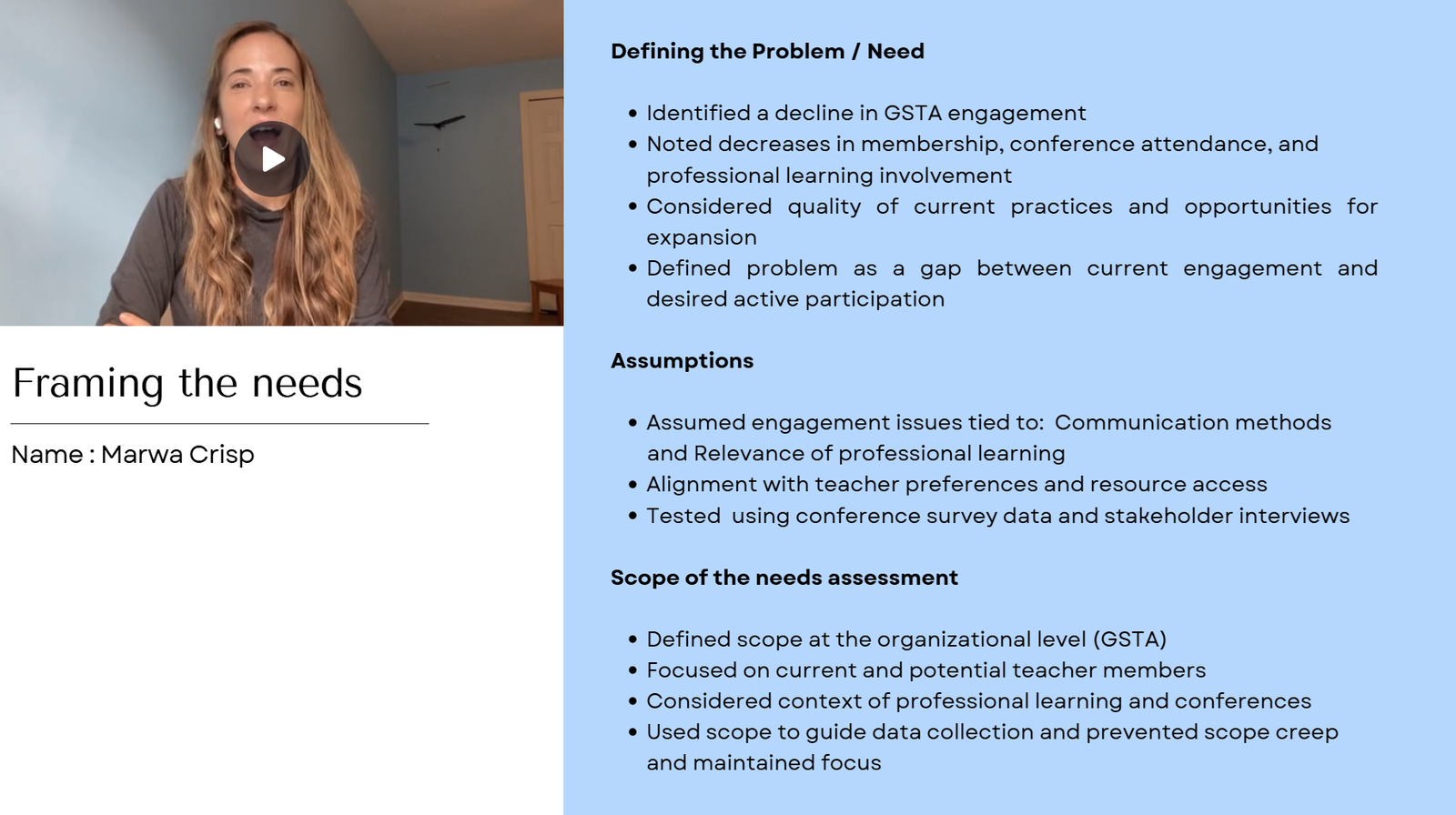
This artifact represents my contributions during the critical problem-framing phase of a comprehensive performance analysis conducted for the Georgia Science Teachers Association (GSTA). Following extensive initial data gathering—spanning digital surveys, target interviews, and user participation trends—our design team worked to define the underlying performance barriers.

As a designer dedicated to keeping user experiences efficient and focused, my role involved creating the structural systems that enabled our team to collaborate seamlessly. I took ownership of our operational framework by engineering our meeting agendas, designing a centralized file repository to optimize team output, and managing cross-functional communication streams. Additionally, I drove stakeholder outreach by planning and executing survey distribution campaigns and tracking key qualitative interview milestones. Through this coordination, we accurately isolated a distinct performance gap between the association's professional development offerings and long-term user engagement.

Justification for Inclusion

I selected this artifact because it highlights my proficiency in orchestrating complex, collaborative learning design initiatives within authentic professional landscapes. Effective design extends far beyond individual execution; it requires building and maintaining the foundational communication networks and logistical data pipes that make deep analysis possible.

By actively leading survey deployment, scheduling intricate stakeholder discussions, and establishing optimized team workflows, I ensured our final decisions were anchored in diverse, reliable data. This experience illustrates my ability to champion a modern, learner-centered design ethos—balancing rigorous data collection systems with a collaborative team environment to ensure optimal project execution.

Value and Self-Assessment

Reflecting on this initiative, it underscores my strength in balancing structural precision with highly adaptive communication skills. Managing several concurrent workflows—from aligning team member outputs to facilitating external stakeholder touchpoints—required a sharp eye for detail and an agile approach to project management.

A key insight from this process was the immense value of capitalizing on unique individual competencies within a design squad. Our team thrived because we distributed ownership dynamically, allowing specialized talents to enhance distinct analytical streams. We also embraced rapid, iterative troubleshooting, allowing us to pivot our outreach methods in response to real-time participant metrics. This project deepens my commitment to building collaborative ecosystems that leverage diverse skills, treat analysis as a foundation for change, and utilize systematic problem-solving to deliver measurable design impact.