Management

Applying assessment and evaluation in instructional design practice.

Non-Instructional Intervention: Communication

Course: EDIT 7150E – Principles of Human Performance Technology and Analysis
Instructor: Dr. Jill Stefaniak
Artifact Type: Non-Instructional Intervention | Organizational Communication System Design | Performance Support Analysis
Focus: Communication systems, performance improvement, information flow, organizational alignment, HPT interventions
Tools: Human Performance Technology (HPT), Communication Systems Analysis, Job Aid Design, Organizational Mapping
Responsibilities:
Analyzed organizational communication systems, designed performance support interventions, evaluated communication networks and feedback loops, identified breakdowns in information flow, and developed solutions to improve clarity, coordination, and organizational alignment.

Non-instructional intervention focused on improving organizational communication through structured systems that support performance, alignment, and information flow. This artifact applies Human Performance Technology principles to analyze communication networks, feedback loops, and workplace communication systems. The design emphasizes clarity, coordination, and performance support across organizational teams.

Problem

Workplace environments often rely on memory-based instruction and lack accessible performance support tools, leading to inefficiencies and inconsistent task execution.

Solution

A non-instructional job aid was designed to provide structured, step-by-step guidance, enabling users to complete tasks independently with increased accuracy and efficiency.

Highlights
  • Selected non-instructional intervention over training to address performance gaps
  • Used job aid format to support real-time task execution
  • Aligned performance support with workplace learning needs
  • Focused on usability and immediate application in professional contexts
Design Decisions and Reflection

Overview

This project focuses on organizational communication intervention, a type of non-instructional intervention that helps improve performance by aligning how information is shared across an organization. A non-instructional intervention is an activity designed to change performance by targeting systems, people, or processes rather than simply providing instruction or instructional intervention alone. In this case, communication intervention focuses on improving how information flows. Communication is a process through which people acting together create, sustain, and manage shared meaning. Organizational communication aligns messages, reduces misunderstandings, and ensures everyone is working toward the same goals.

Effective communication is critical because it ensures coordination, reduces misunderstanding, and aligns actions with organizational goals. Poor communication can create errors, reduce engagement, and slow performance. Within the Human Performance Technology Model, organizational communication is one type of intervention alongside learning, performance support, and human resource development.

This project included several communication interventions. Communication networks describe how messages flow in an organization, including formal chains of command and informal peer-to-peer channels. Information systems provide structured ways to deliver consistent information such as dashboards or newsletters, helping standardize messages across teams. Suggestion systems allow employees to submit ideas, recommendations, or feedback to leadership. Grievance systems provide formal ways for employees to communicate concerns safely. Dispute resolution systems help resolve conflicts through structured communication rather than escalation. Cross-functional alignment ensures different departments are on the same page. Feedback loops help check understanding and adjust communication as needed.Communication barriers such as noise, jargon, unclear channels, and competing messages can distort information and reduce understanding. These barriers impact coordination and alignment across an organization.

Justification for Inclusion

This artifact is placed under Management because it directly demonstrates the ability to plan and manage instructional design activities and projects through structured communication systems. Management in instructional design is not only about creating learning solutions, but about coordinating systems, people, and processes so that work can be implemented effectively. Organizational communication intervention is a focus on how information is structured, delivered, monitored, and improved across teams. It shows how communication networks, information systems, feedback loops, and formal processes such as suggestion, grievance, and dispute resolution systems support project coordination, alignment, and performance. This makes the intervention a clear example of managing how work is organized and how people interact within a system to achieve shared goals.

Value and Self Assessment

Including this artifact in my portfolio is important because it demonstrates my ability to think beyond instruction and design at a systems level. It shows that I understand how performance is influenced by communication structures and how improving those structures supports organizational effectiveness. This connects directly to my growth as an instructional designer because it reflects my ability to manage design challenges, collaborate with teams, and support clients through structured communication processes. It also supports my broader professional goal of working in learning experience design, where managing communication, alignment, and stakeholder understanding is essential to successful project outcomes. This artifact highlights my ability to design interventions that improve coordination, reduce misunderstandings, and strengthen overall performance through intentional communication system design.

Needs Assessment Decisions

Course: EDIT 7150E – Principles of Human Performance Technology and Analysis
Instructor: Dr. Jill Stefaniak
Artifact Type: Needs Assessment Decision Artifact | Collaborative Design | Human Performance Technology (HPT)
Focus: Needs analysis, performance gap identification, stakeholder collaboration, decision-making, systems thinking
Tools: Canva, Human Performance Technology (HPT), Stakeholder Analysis, Collaborative Design, Data Collection Systems
Responsibilities:
Supported collaborative needs analysis by organizing stakeholder input, coordinating communication and scheduling, facilitating data collection efforts, assisting with survey outreach, and contributing to structured decision-making processes for identifying performance gaps.

Collaborative needs assessment artifact focused on identifying performance gaps and guiding decision-making through structured analysis of stakeholder data. This work applies Human Performance Technology principles to support systems thinking, coordination, and evidence-based instructional design decisions.

Problem

Organizations and instructional teams often struggle to clearly define performance gaps and prioritize needs without a structured analysis process.

Solution

A collaborative needs assessment decision artifact was created using Canva to visually organize data, group input, and guide decision-making through structured human performance analysis.

Collaboration & Management Focus

This artifact highlights group-based design thinking, shared decision-making, and structured facilitation of needs analysis—emphasizing coordination, alignment, and collective interpretation of data.

Key Highlights
  • Demonstrates collaborative needs analysis and decision-making
  • Applies human performance technology (HPT) frameworks
  • Organizes stakeholder input into structured visual decision artifacts
  • Supports identification of performance gaps and priorities
  • Developed using Canva as a collaborative design tool
Design Decision and Reflection

Overview

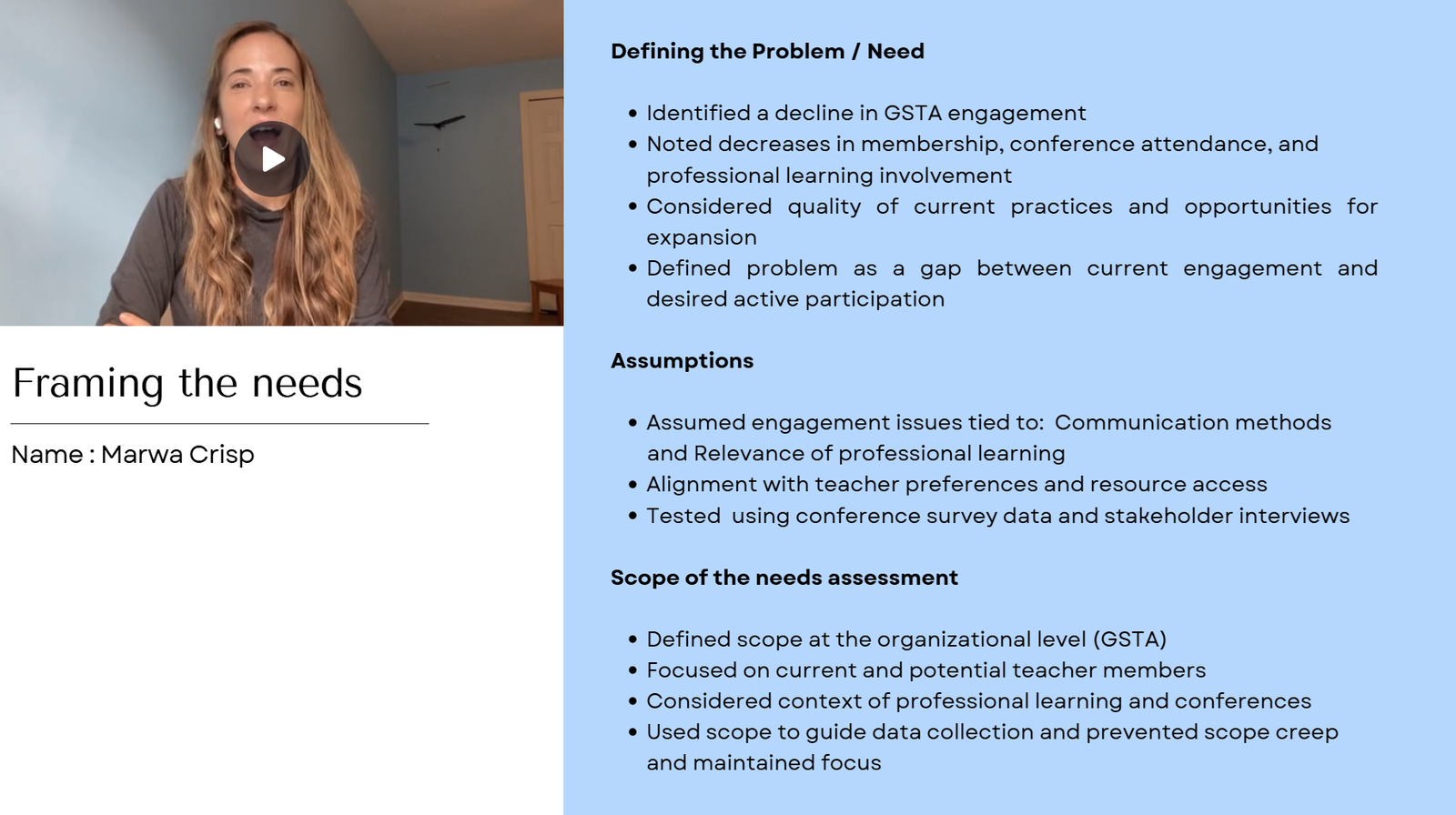
This artifact represents my contribution to the framing the need phase of a collaborative needs assessment conducted for GSTA. After initial data collection through surveys, interviews, and participation analysis, our team worked to define and refine the core problem guiding the project. My role extended beyond analysis and included key management responsibilities that supported the structure of the project itself. I helped coordinate early project organization by developing an initial meeting plan, organizing shared files for team efficiency, and supporting communication across group members. I also applied networking skills to support stakeholder engagement, distributed flyers to promote participation in the digital survey, and assisted in scheduling and tracking interviews with key stakeholders.

Through these combined efforts, our team was able to frame the problem as a gap between GSTA’s professional learning offerings and sustained member engagement. This framing emerged from synthesizing stakeholder input, participation data, and organizational context, and it provided the foundation for all subsequent phases of the needs assessment.

Justification for Inclusion

I selected this artifact because it demonstrates my ability to manage instructional design activities in a real, collaborative project context. My contributions were not limited to analyzing information but included organizing the logistical and communication structures that made the needs assessment possible. Distributing flyers for the digital survey, coordinating interview scheduling, and tracking stakeholder participation ensured that we had access to meaningful and diverse data sources.

Additionally, my work in organizing files and building an initial team meeting structure supported project efficiency and reduced confusion during the early stages of collaboration. These actions directly align with the management theme because they reflect planning, coordination, and the ability to support a team in executing a structured design process. Without these organizational systems and outreach efforts, our ability to gather sufficient stakeholder data and maintain project momentum would have been limited.

Value and Self Assessment

In reflecting on my role, I believe I demonstrated strength in coordination, organization, and stakeholder communication. I was proactive in supporting both the logistical and relational aspects of the needs assessment process, particularly in ensuring that interviews were scheduled, data collection efforts were supported, and team materials were structured in an accessible way. I also used networking strategies to help expand participation and increase response rates for our digital survey, which strengthened the overall data set.

One area for growth is continuing to develop my ability to delegate and distribute management tasks more evenly across a team. While I took initiative in organizing systems and scheduling, I recognize that more intentional task distribution could improve efficiency and shared ownership. I also want to strengthen how I anticipate project needs earlier in the process, particularly in identifying potential bottlenecks before they emerge.

This experience strengthened my understanding of instructional design as a management-driven process that requires both organization and collaboration. I learned that effective needs assessment work depends not only on data analysis but also on how well the project is structured, coordinated, and supported behind the scenes. Managing logistics such as interview scheduling, file organization, and stakeholder outreach directly influenced the quality and completeness of our data collection.

This artifact also reinforced the importance of networking and communication in instructional design projects, especially when working with real organizations and external stakeholders. Moving forward, I will apply these skills by being more intentional in project planning, strengthening early organizational systems, and ensuring that collaboration structures support both efficiency and equity in team contributions.