Evaluation and Implementation

Human-Centered Evaluation Plan: Online Leadership Development Program

This artifact highlights a human-centered, mixed-methods evaluation plan developed for an online leadership development program. Using a logic model as the foundation, the evaluation aligned learner experiences, instructional activities, and organizational goals to examine engagement, skill transfer, and long-term impact. Evaluation was treated as an iterative sensemaking process rather than a final checkpoint.

Tools Used: Logic Modeling, Surveys, Interviews, Reflection Instruments, Evaluation Matrices

Key Concepts: Human-Centered Evaluation, Formative & Confirmative Assessment, Adult Learning Theory, Social Learning, Mixed-Methods Research, Learning Transfer
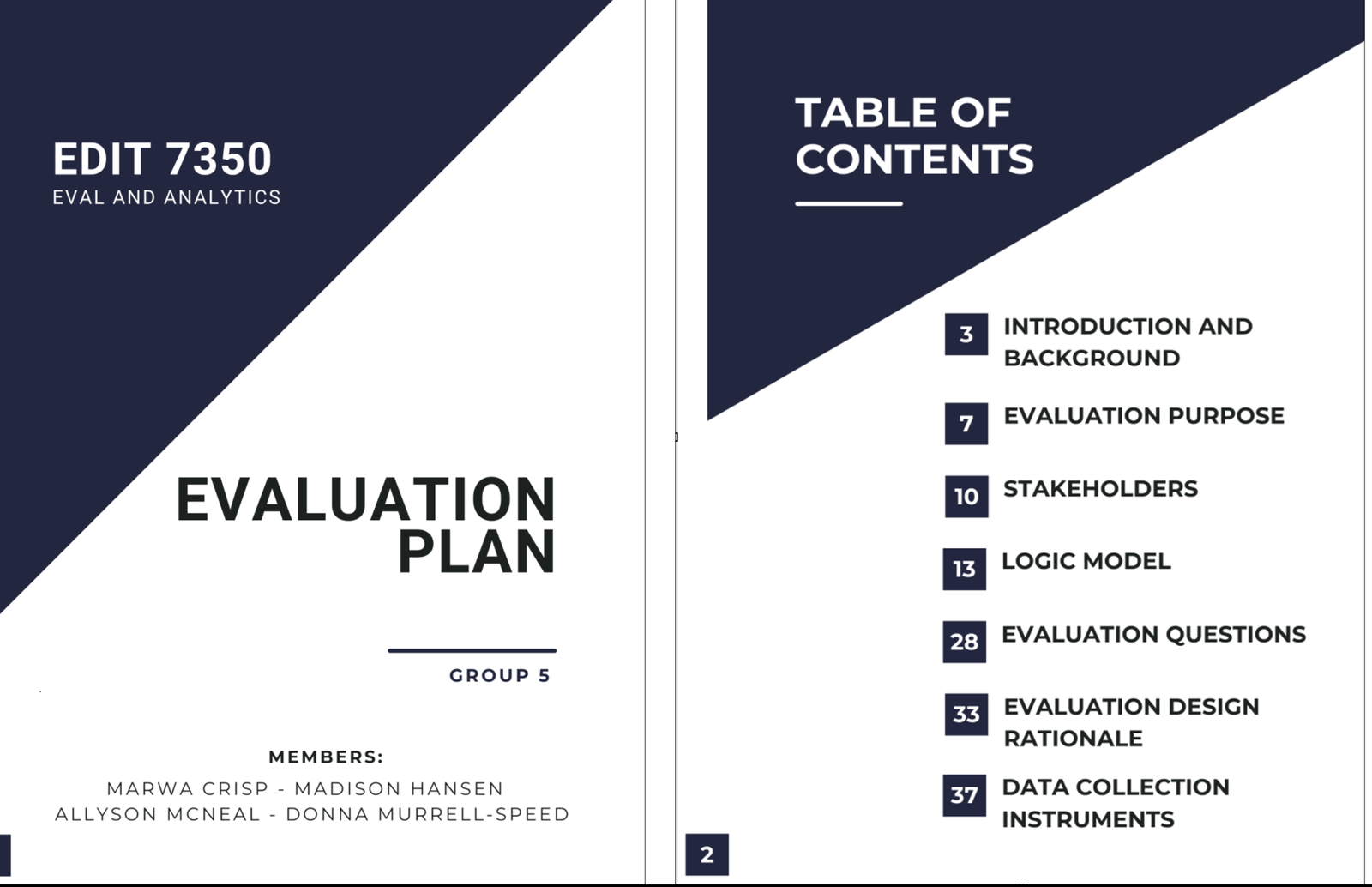
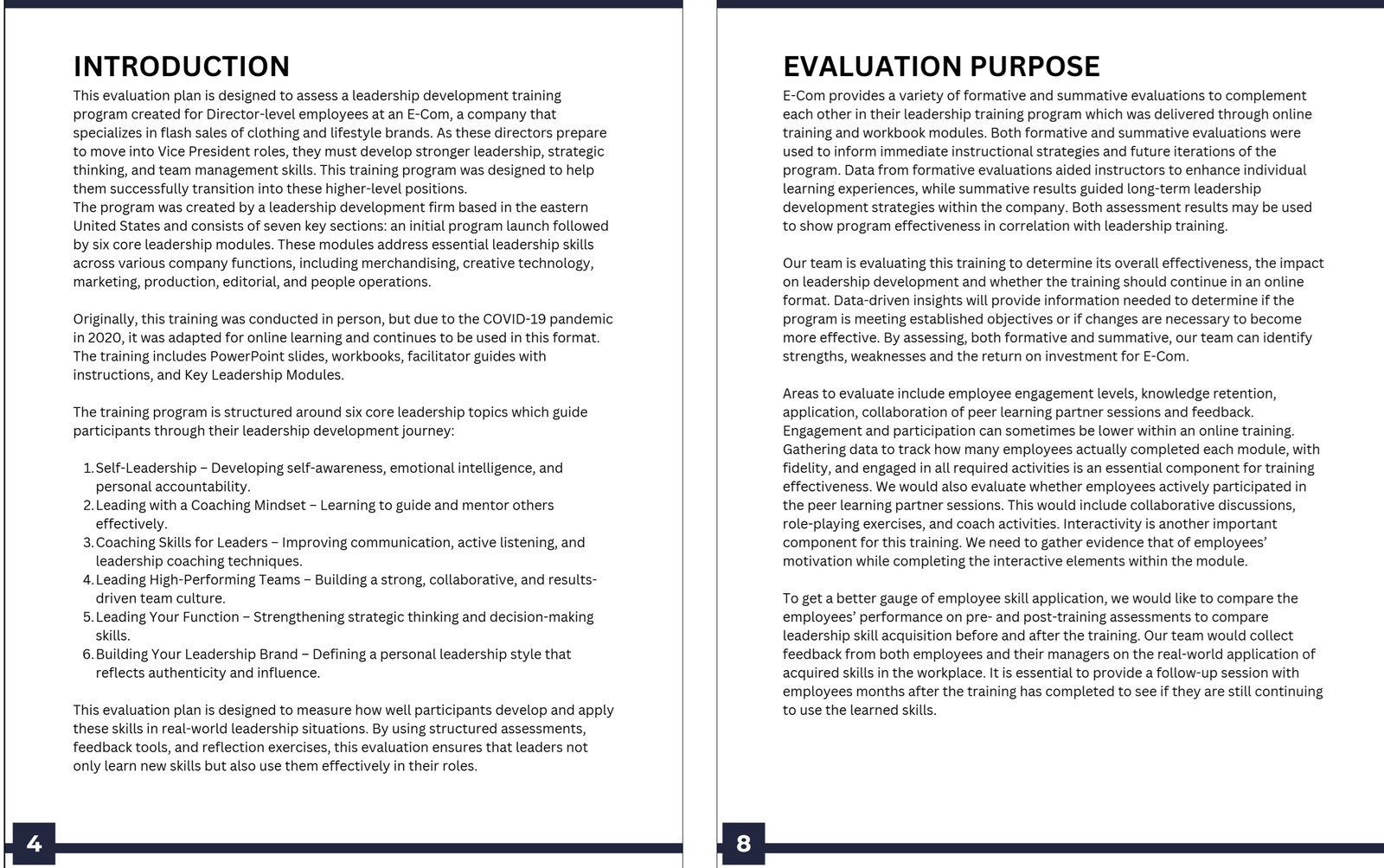
Evaluation Logic Model Overview Evaluation Plan and Methods Overview
Instructional Challenge

A leadership development program transitioned from in-person to online delivery, requiring a deeper understanding of learner engagement, skill transfer, and long-term effectiveness within a complex organizational system.

Evaluation Strategy

A logic model was developed to align inputs, learning activities, outputs, and outcomes. The evaluation plan integrated formative, summative, and confirmative methods to surface learner voice, peer learning dynamics, and real-world application over time.

Human-Centered Design Lens

Evaluation emphasized reflection, feedback, and collaboration through learner workbooks, peer coaching artifacts, surveys, and interviews. Learners and stakeholders were treated as contributors to insight, not passive data sources.

Key Highlights
  • Logic model used as both an evaluation and design-alignment tool
  • Mixed-methods data collection capturing experience and behavior change
  • Formative feedback loops embedded throughout the learning experience
  • Confirmative evaluation to assess sustained impact beyond program completion
  • Evidence-informed recommendations for continuous program improvement

Evaluation & Implementation – Assessment & Evaluation Artifacts

This artifact presents a curated compilation of formative assessments, summative measures, and evaluation tools used to support instructional decision-making and continuous improvement. The collection demonstrates how assessment evidence is gathered, interpreted, and applied within a human-centered evaluation framework.

Tools Used: Microsoft PowerPoint, Reflection Logs, Surveys

Key Concepts: Formative Assessment, Summative Assessment, Program Evaluation, Higher-Order Thinking, Scaffolding, Proficiency Scales, Instructional Alignment, Human-Centered Evaluation
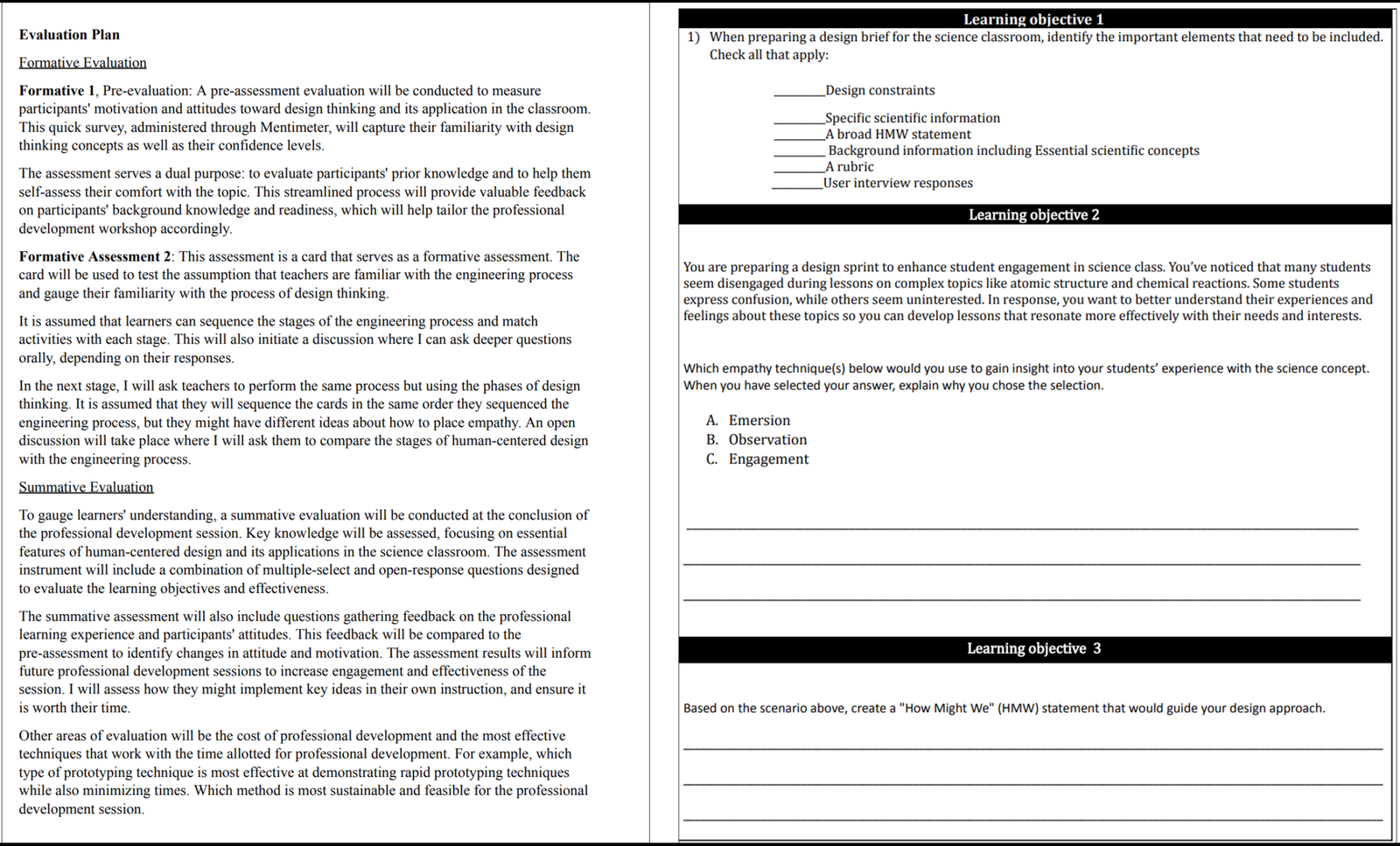
Assessment and Evaluation Artifact Screenshot 1
Assessment and Evaluation Artifact Screenshot 2
Problem

Learning experiences require aligned assessment and evaluation strategies to generate meaningful data that informs instruction and measures outcomes.

Solution

Developed a compilation of diagnostic, formative, summative, and evaluative tools designed to capture learner progress, instructional effectiveness, and program impact.

Future Integration

This collection supports expansion into a comprehensive evaluation system that integrates learner feedback, performance data, and continuous improvement cycles.

Highlights
  • Includes formative, summative, and evaluation artifacts
  • Supports data-informed instructional decisions
  • Aligned to learning objectives and proficiency expectations
  • Designed for scalability across learning contexts
  • Grounded in human-centered evaluation practices