
Professional Foundations

In-person Participant & Facilitator Guides: Adult Learning in Professional Development

These participant and facilitator guides translate adult learning theory into actionable, classroom-ready professional development resources. Designed for in-person workshops with teachers in Metro Atlanta, the guides are grounded in social learning and constructivist principles. Participants engage in AI-supported empathy exercises, empathy maps, and modeled design thinking techniques to collaboratively explore real-world classroom problems, build shared understanding, and reflect on practice.

Tools Used: Microsoft Word, PowerPoint, Canva, Adobe PDF

Key Concepts: Adult Learning Theory, Social Learning, Constructivism, Design Thinking, Empathy, Professional Learning
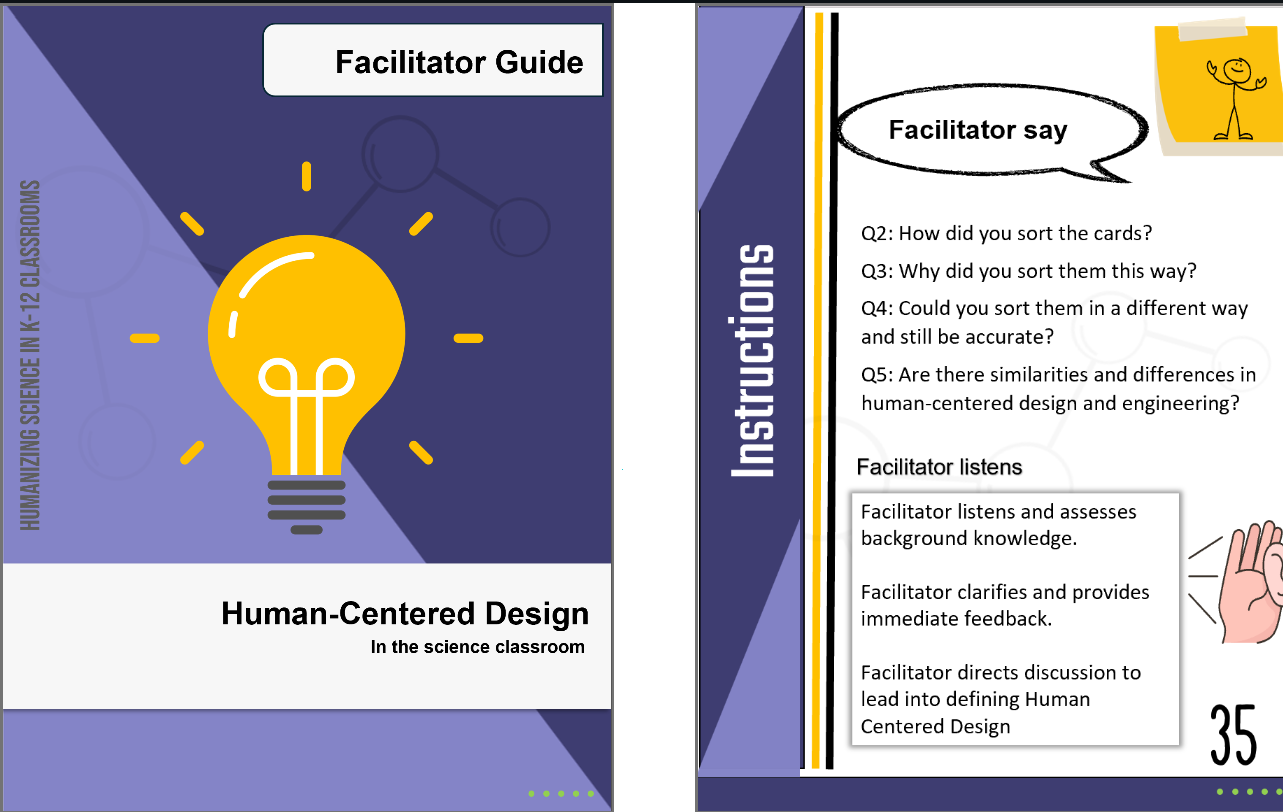
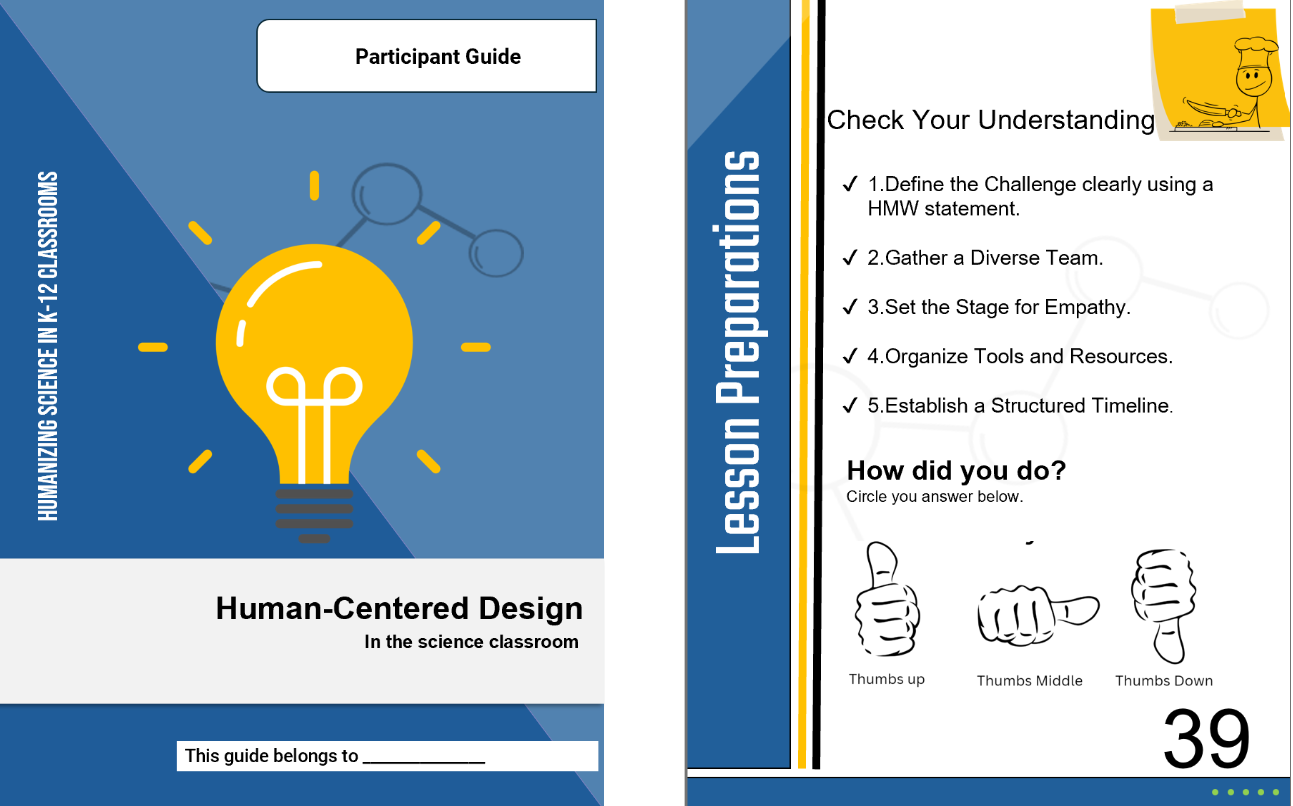
Facilitator Guide Preview Participant Guide Preview
The Problem

Professional development often focuses on tools and strategies without first building empathy for learners or modeling the learning process teachers are expected to use. As a result, learning can feel passive and disconnected from real classroom challenges.

The Learning Solution

These guides support facilitators in leading inquiry-driven workshops where participants engage in AI-supported empathy exercises, use empathy maps to surface learner needs, and experience modeled design thinking techniques. Collaboration and real-world problem solving anchor learning in authentic classroom contexts.

Why This Approach Works
  • Learning is social and constructivist, built through dialogue, collaboration, and shared meaning-making
  • Social learning is reinforced through facilitator modeling and peer interaction
  • Adult learning principles are honored by centering relevance, experience, reflection, and application

Theory in Practice Paper: Applying Adult & Social Learning Theories

This paper discusses how I apply constructivism, cognitivism, behaviorism, and sociocultural theory within a human-centered design framework. It demonstrates how adult and social learning theories guide my instructional design decisions to create engaging, learner-centered, and practical experiences, particularly for professional and workplace contexts.

Tools Used: Microsoft Word, Adobe PDF

Key Concepts: Adult Learning Theory, Social Learning, Constructivism, Cognitivism, Behaviorism, Human-Centered Design
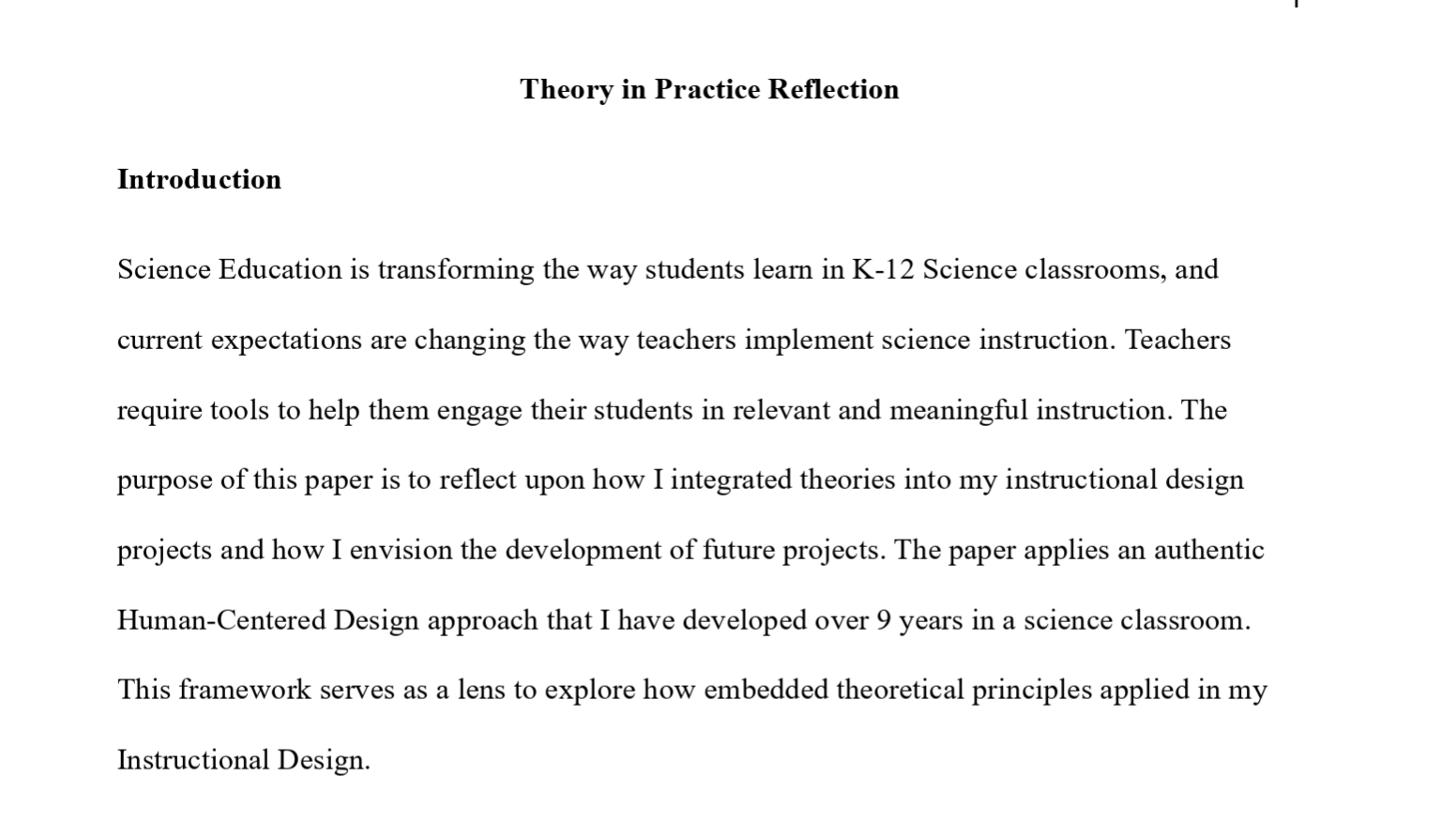
Paper Screenshot 1
Problem

Designing effective, engaging learning experiences for adult learners requires balancing multiple learning theories, leveraging prior experience, and fostering collaboration while maintaining a human-centered focus.

Solution

In this paper, I demonstrate how I apply constructivist, cognitivist, and behaviorist strategies, as well as adult learning and sociocultural theory, within a human-centered design framework. Learners explore, ideate, and prototype solutions while engaging socially and collaboratively, allowing learning to connect to real-world problems and professional contexts.

Summary & Key Highlights
  • Illustrates application of adult learning theory to professional and workplace contexts
  • Shows how social and constructivist approaches promote collaboration and problem-solving
  • Demonstrates scaffolding, reinforcement, and learner-centered instructional strategies
  • Integrates human-centered design principles to align learning with real-world needs
  • Models blended learning environments with AI, hands-on, and digital exploration
  • Provides a scalable approach for Design Sprints and collaborative professional learning

Online Position Paper: Adult Learning & Online Instruction

This paper reflects on my epistemological framework and its influence on online instruction. It explores how adult learning theory, social learning, and inquiry-based strategies inform the design of online learning experiences. AI and technological tools are leveraged to personalize learning, support collaboration, and facilitate engagement in inquiry-driven online environments.

Key Concepts: Adult Learning Theory, Online Learning, Andragogy, Social Learning, Inquiry-Based Learning, AI Integration
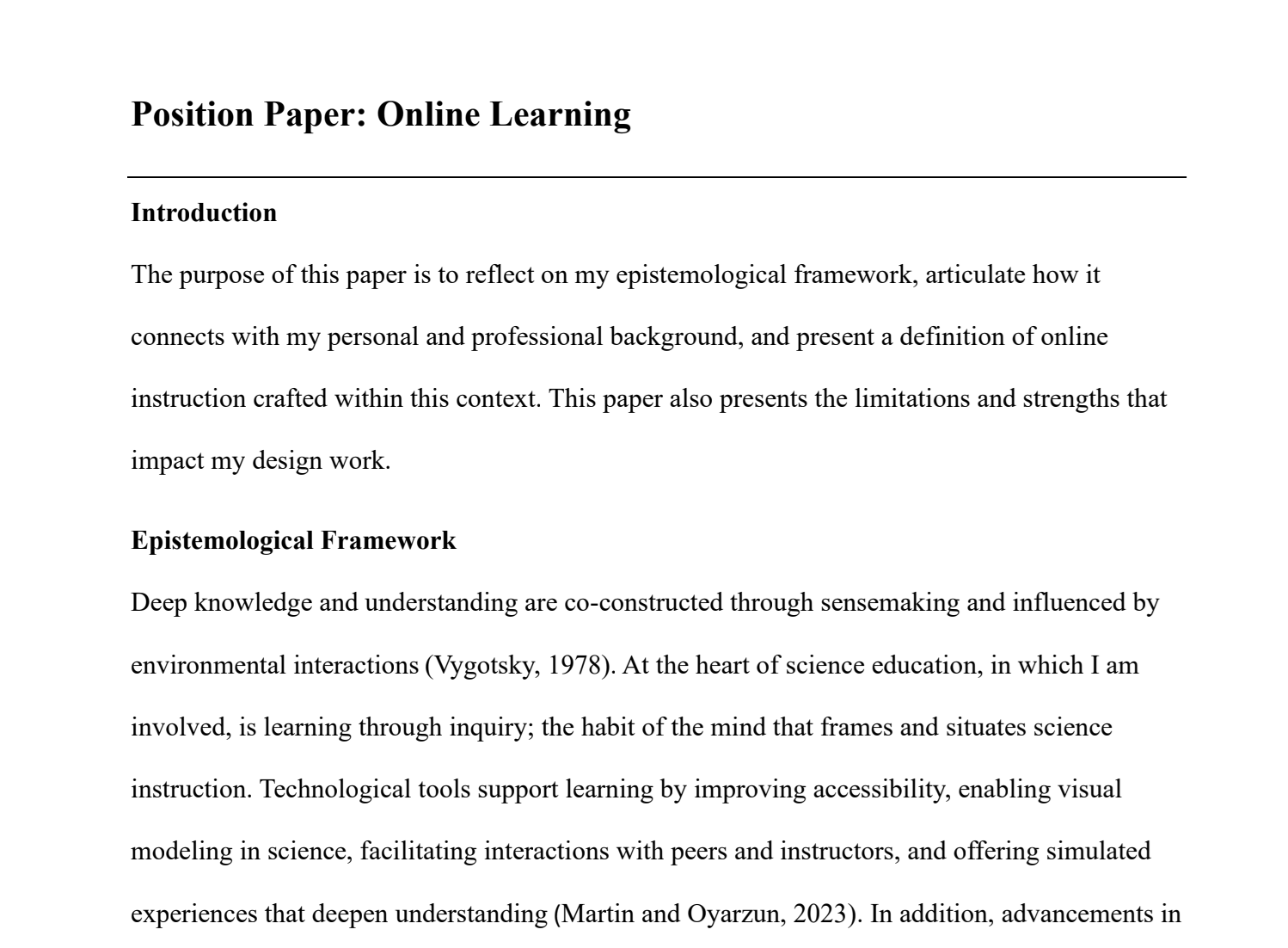
Online Position Paper Preview 1 Online Position Paper Preview 2
The Problem

Designing online learning that is equitable, engaging, and inclusive while honoring adult learning principles and supporting social interaction remains a challenge. Many online experiences fail to balance inquiry, collaboration, and personalization.

The Learning Solution

This paper outlines how adult learning theory, social learning, and inquiry-driven strategies inform online design. AI and other technologies are leveraged to personalize learning, facilitate collaboration, and provide authentic, reflective learning opportunities.

Why This Approach Works
  • Learning is social and constructivist, grounded in dialogue, collaboration, and shared sense-making
  • Adult learning principles are honored by centering relevance, experience, reflection, and application
  • AI-supported tools enable personalization and scaffolded engagement in online inquiry cycles
  • Design is intentional, inclusive, and responsive to learner context and diversity

Foundations of Message Design: Dual Coding Theory in Media

This video artifact presents research-based insights on Dual Coding Theory and its application to effective message design in digital and instructional media. Grounded in cognitive science, the video explores how information is processed through both verbal and nonverbal channels and why intentionally designing for both pathways can significantly improve comprehension, retention, and clarity.

The presentation also examines common pitfalls that occur when designers overload one channel, misalign visuals and text, or introduce unnecessary decorative elements that increase cognitive load. By analyzing both effective and ineffective examples, the video demonstrates how dual coding can serve as a foundational design principle across media formats — including instructional videos, slide decks, eLearning modules, and digital content creation.

Tools Used: Video Production & Research-Based Instructional Design

Key Concepts: Dual Coding, Cognitive Load, Verbal & Nonverbal Processing, Message Design, Multimedia Learning

UPLOAD VIDEO SCREENSHOT HERE
(Slide showing dual coding example)

Replace this entire div with your image tag.
UPLOAD VIDEO SCREENSHOT HERE
(Example demonstrating cognitive load pitfall)

Replace this entire div with your image tag.
Problem

Many media artifacts unintentionally overwhelm learners by combining dense text, narration, and competing visuals without intentional alignment. This results in increased cognitive load, fragmented processing, and reduced message clarity.

Solution

This video models how to intentionally integrate dual coding principles into message design by aligning visuals with explicit verbal labels, reducing extraneous elements, and designing with awareness of how the brain processes information through separate but interconnected channels.

Highlights
  • Explains the theoretical foundation of Dual Coding Theory
  • Connects cognitive load principles to media design decisions
  • Identifies common pitfalls in multimedia presentations
  • Provides practical strategies for aligning visuals and verbal content
  • Positions dual coding as a foundational principle for all media design